Batanes Regional Food and the Honest Truth About Getting There
Honest guide to Batanes food: uvud, coconut crab, pangasi, real prices, and why your flight might board a different plane than expected.
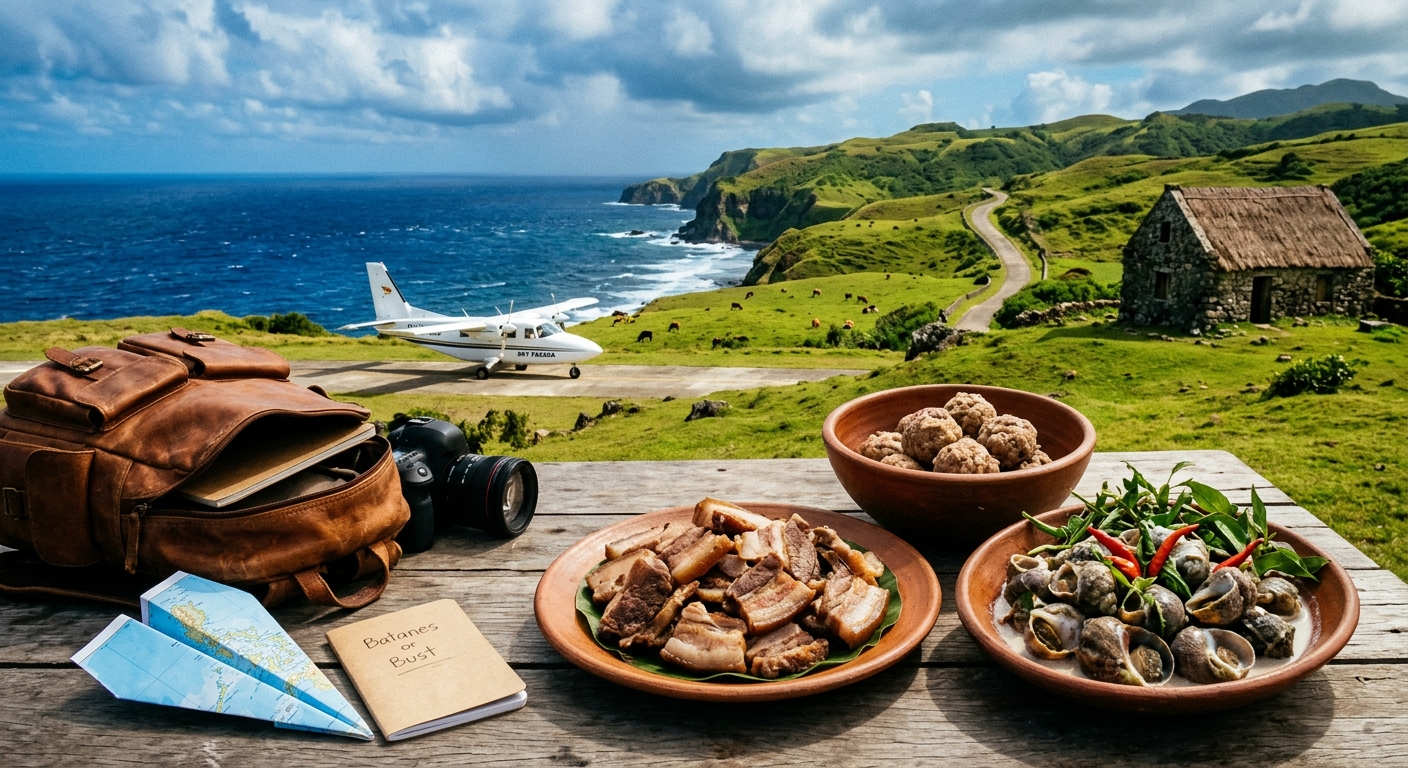
You do not fly to Batanes for convenience. You fly there because you have decided the food and the landscape justify the cost, the logistics, and the occasional bout of low-cloud anxiety as the small aircraft drops toward Basco Airport. The payoff, on the food side at least, is real. But a lot of what gets written about Ivatan cuisine online was filed by someone who spent two days on a press trip with a pre-arranged itinerary. This piece was not. Here is what you actually find when you eat your way through Batanes, what it costs, and why your flight north might feel stranger than anything in your booking confirmation suggested.
The Short Version
- Ivatan food is genuinely distinct from anything else in the Philippines and rewards eating slowly rather than photographing quickly.
- Coconut crab is overhyped, heavily restricted, and not reliably available to walk-in visitors at any price.
- Your Batanes flight may board under one airline name but operate on a different carrier's aircraft and crew, and there is a practical reason for it.
What Makes Ivatan Food Different from the Rest of the Philippines
Ivatan cuisine was built around survival in a typhoon-prone island chain far north of mainland Luzon. Batanes is closer to Taiwan than to Manila, and the Ivatan people developed a food culture shaped by isolation, limited supply chains, and the need to preserve ingredients through storms that can shut down everything for weeks. The result is a cuisine that is heavier, earthier, and more self-contained than anything you encounter in Cebu, Ilocos, or Bicol.
Fresh seafood is not the centerpiece here, despite the sea surrounding the islands. Fishing during typhoon season is often impossible. Preservation techniques dominate instead. Taro replaces rice in many dishes. Coconut milk is used more as a base than a flourish. Meat is smoked and dried rather than cooked fresh. You are eating food that was designed to last, not to impress a visitor. That is exactly what makes it interesting.
Food historians have documented Ivatan culinary practices as one of the more self-contained regional food systems in the Philippine archipelago, drawing almost entirely on locally cultivated or preserved ingredients rather than imports from the mainland. That closed-loop quality is not incidental. It is the defining characteristic of everything you eat here.
Uvud and Vunes: Eating What Batanes Actually Lives On
Uvud is the dish you will encounter everywhere. It is pounded taro corm cooked in coconut milk, sometimes with pork or chicken folded in, sometimes plain. The texture is dense and starchy in a way that is unfamiliar if your only reference for taro is the purple filling in a milk tea. Eaten properly, with rice and the cooking liquid ladled over everything, it is filling, savory, and genuinely satisfying. At the carinderias near the Basco public market, a plate of uvud as part of a rice meal runs PHP 100 to PHP 130. At guesthouse dining setups like Pension Ivatan, the same dish in a slightly more curated context costs PHP 180 to PHP 220.
Vunes is smoked pork preserved using Ivatan technique. The smoking produces a dense, dry, intensely flavored meat that is unlike commercial smoked pork anywhere else in the country. It is not subtle food. It is food built for longevity and flavor concentration. You can eat it as a viand at a carinderia or buy it by the kilo to take home. Home producers in Batanes sell vunes for roughly PHP 400 to PHP 600 per kilo depending on season. It keeps well for travel and holds its flavor for days, which is more than you can say for most food purchases made on a trip.
Coconut Crab: The Honest Assessment Nobody Puts in the Travel Brochure
Every Batanes article mentions the coconut crab. Most of them do not mention that the coconut crab, locally called tatu or tatus, is a regulated species with harvesting restrictions enforced in Batanes. Walk-in visitors cannot reliably order one. What appears on occasional menus is tied to local quotas, season, and the discretion of the individual establishment. If you build your Batanes trip around eating coconut crab, there is a real chance you leave disappointed.
When it is available, the price reflects both the size of the crab and the rarity of the occasion. Expect PHP 1,200 to PHP 2,500 for a prepared crab at a proper establishment. The flavor is rich and buttery with a sweetness that is unlike regular crab. It is genuinely worth eating if the opportunity presents itself organically. But it is not something you can schedule. Treat it as a bonus, not a reason to book.
Pangasi and the Quiet Ritual of Ivatan Hospitality
Pangasi is Ivatan fermented rice wine. It is mildly alcoholic, slightly cloudy, with a sour finish that takes some adjustment. You will not find it on restaurant menus in any consistent way. It appears in guesthouse settings, offered by hosts in the evening, and occasionally at local gatherings. If you stay somewhere family-run and ask about it, most hosts are happy to share a glass.
The honest take: pangasi is worth trying once, not because it will become your preferred drink, but because it tells you something about how Ivatan hospitality works. It is communal and unglamorous. There is nothing staged about it. That makes it more interesting than most things you will drink on any food trip in the Philippines.
Batanes Dishes Side by Side: Worth It or Worth Tempering Your Expectations?
| Dish | What It Is | Typical Price | Honest Take |
|---|---|---|---|
| Uvud | Pounded taro in coconut milk, often with pork | PHP 100 to 220 | Order it every day. This is what Batanes food actually is. |
| Vunes | Smoked preserved pork, Ivatan-style | PHP 400 to 600 per kilo | Buy some to take home. The flavor is worth it. |
| Coconut Crab (Tatu) | Protected terrestrial crab, restricted harvest | PHP 1,200 to 2,500 | Unavailable more often than not. Do not plan your trip around it. |
| Pangasi | Fermented rice wine, lightly sour | Complimentary to PHP 80 | Try once for the experience, not the taste. |
Carinderias vs. Guesthouses: Where Your Budget Actually Goes in Basco
Basco is the capital and the food hub. You are not choosing between dozens of restaurants. The options are small in number and genuine in character. The carinderias near the public market are the best value by a significant margin. They run turo-turo style, meaning you point at what looks good and get it plated immediately. For PHP 100 to PHP 150, you eat a full meal with rice and two or three viands. Uvud and vunes show up here reliably. Whatever was fresh or prepared that morning shows up too.
Guesthouse home kitchens sit a step above in price and comfort but remain good value by any Philippine standard. These are family operations where the cook is also the host, portions tend to be generous, and the food reflects what the family actually eats. Budget PHP 200 to PHP 350 for a full meal at this tier. Smaller guesthouses like Marfel's Lodge and similar family-run setups are where this kind of home-kitchen dining happens most naturally. The more formal dining at Pension Ivatan is reliable and slightly more structured, which some visitors prefer, especially after a long travel day.
One thing worth knowing: many carinderias in Basco open early and close once the food is gone. If you arrive for lunch at one in the afternoon expecting a full spread, you may find empty pots. Get there before noon. The food is better for it anyway.
The Flight to Batanes and Why It Might Feel Off
Getting to Batanes from Manila or Tuguegarao involves one of the thinnest commercial air routes in the Philippines. Basco Airport (IATA: BSO) handles a low volume of flights. The Manila to Basco leg runs roughly one hour and forty minutes. The Tuguegarao to Basco hop takes around forty-five minutes. Neither leg is long, but both routes are logistically unusual in ways that catch first-time visitors off guard.
The most common point of confusion is this: you book a flight under one airline name, arrive at the gate, and board what feels like a completely different airline. The livery on the aircraft is different. The crew uniforms are different. The safety card in the seat pocket references a carrier you have never heard of. A plain-language breakdown of wet lease explained as an aviation concept covers exactly why this happens: the carrier on your ticket has contracted another operator to run the flight using that operator's own aircraft and crew. Your booking is valid and confirmed. You are simply flying on hardware that belongs to a different company.
Thin routes like Batanes use this arrangement because stationing a carrier's own aircraft and crew permanently in a remote northern location is expensive. The wet-lease model lets the marketing carrier put its name on the route without absorbing the full operational cost. For passengers, the practical consequences are minor but worth knowing about before you land at the terminal looking confused.
Before confirming your Batanes booking, these four steps will save you friction on travel day:
- Check the operating carrier field on your booking confirmation, which is a separate field from the marketing carrier name shown at the top of your ticket.
- Confirm baggage allowances directly with the operating carrier, as they sometimes differ from the marketing carrier's published rules.
- Verify which check-in counter to use at the airport. Wet-leased flights sometimes check in under the operating carrier's desk rather than the carrier you booked through.
- Calibrate your expectations for onboard service. On a forty-five-minute to one-hour-forty-minute route to a remote island, you get a snack at best and gratitude for a smooth landing.
What Stays with You After Batanes: The Food, Not the Flight
The flight confusion fades the moment you land and the food starts. A week after you leave Batanes, you will not be thinking about which carrier operated your outbound leg. You will be thinking about the carinderia near the market that opened at seven in the morning with no sign on the door and a pot of uvud already on the stove.
PHP 120 bought a full plate and a cup of brewed coffee. The uvud was dense and slightly sweet from the coconut milk, with small pieces of pork that had taken on the flavor of the taro. The vunes on the side was sharply smoked and chewy in a way that anchored everything else on the plate. It was not a composed meal. It was breakfast in Batanes, which turns out to be its own category of good.
Ivatan food does not try to impress you. It does not need to. It is the product of a community that cooked for itself long before tourists started booking flights north, and that history sits in every bowl of uvud and every strip of smoked meat. The flight to get there is logistically annoying and occasionally strange. The food waiting at the other end makes it worth every minute of the planning.
Read next
-
 Eating Well at Philippine Ferry Ports and Bus Terminals in the Visayas
Puso, sinuglaw, and freshly fried chicharon at Cebu's Pier 1, the Ormoc bus depot, and Dumaguete's waiting sheds. A solo traveler's guide to Visayas transit food.
Eating Well at Philippine Ferry Ports and Bus Terminals in the Visayas
Puso, sinuglaw, and freshly fried chicharon at Cebu's Pier 1, the Ormoc bus depot, and Dumaguete's waiting sheds. A solo traveler's guide to Visayas transit food.
-
 What I Research Before Eating in a Philippine City for the First Time
My pre-arrival research process for eating well in any Philippine city, from Dumaguete to Vigan, because every city eats differently.
What I Research Before Eating in a Philippine City for the First Time
My pre-arrival research process for eating well in any Philippine city, from Dumaguete to Vigan, because every city eats differently.